
Soil Nematodes Ecology
Soil Nematodes Ecology
To apply knowledge of nematodes in agriculture and environmental monitoring, the nematodes need to be identified at least to the family level and then these taxa are classified into one of five colonizer-persister classes (c-p) for the free-living nematodes (c-p 1-5) and into one of four classes for the plant-parasitic nematodes (pl 2-5) (Bongers & Bongers 1998; Bongers & Ferris 1999; Bongers et al. 1995; Ferris & Matute 2003).
The role of nematodes in agriculture must be approached holistically with the entire nematode community (bacterivores, fungivores, herbivores, carnivores/predaceous, and omnivores) and the sub taxa within these guilds that are used to formulate the ecological indices.
Information on the purpose, ranges, and ecological relevance of nematode-based indices assist in the choice and interpretation of these indices. The table presented below contains comprehensive information that makes nematode data generated and analyzed make sense as its ecological implication is explained and thus eliminates subjective interpretation of data and results (adapted from Sánchez-Moreno and Ferris, 2018)
Ecological Relevance of Nematode-based Indices in relation to soil conditions
Nematode Ecological Index | Measures
| |
1 | Maturity Index (MI) | Perturbation and environmental disturbance
|
2 | Maturity Index 2-5 (MI2-5) | Non-nutrient based perturbations in agricultural fields and environmental disturbance
|
3 | Plant-Parasitic Index (PPI) | Abundance and composition of the plant-parasitic nematodes
|
4 | PPI/MI | This ratio is a sensitive indicator of enrichment in agroecosystems |
5 | Summation Maturity Index (ΣMI) | Perturbations in non-agricultural soils and environmental disturbance |
6 | Enrichment Index (EI) | Nutrient enrichment and food availability |
7 | Structure Index (SI) | Soil food wed structure and complexity; disturbance due to environmental or anthropogenic causalities |
8 | Channel Index (CI) | Predominant decomposition pathway of organic matter |
9 | Basal Index (BI) | Food web structure and complexity |
10 | Metabolic Footprints (MFs) | Magnitude of ecosystem functions and services carried out by the nematode community |
Real-time changes and evolution of soil conditions
Soil nematode faunal analysis reveals soil conditions (Ferris et al. 2001; Sieriebriennikov et al. 2014).
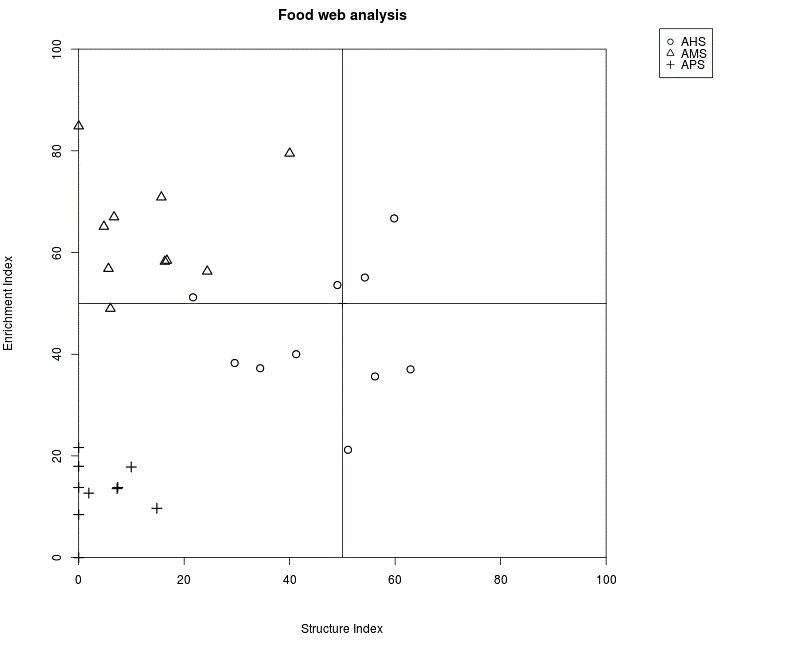
When the nematode data is fed into the automated NINJA system, the nematodes map in one or more of the sectors illustrated below as A, B, D, & C. Healthy stable soils will map in sectors B & C as explained below, while mapping concentrated in sector D will be unhealthy poorly conserved soils. This type of faunal analysis could be used to track changes or the evolution of soil conditions in real-time and therefore used to determine and elucidate soil conditions associated with such changes and soil ecological conditions that support stable and healthy soils.
NINJA: Nematode Indicator Joint Analysis is a tool for nematode-based monitoring of soil quality. It calculates indices based on a taxonomic inventory and provides information on ecosystem attributes and metabolic footprints (Sieriebriennikov et al., 2014)
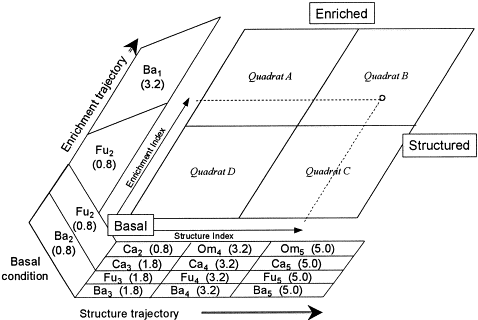
Nematode faunal diagram food web condition description
Sector A
| Sector B
| Sector C
| Sector D
|
Example: Soil nematode data from wheat fields at three different sampling times (Matute et al. 2015). The nematodes mapped mostly in sectors A and D